LES ENFANTS.
- Les enfants sont spontanément philosophes : ils posent des questions.
- Et les adultes ?
- Les adultes sont spontanément idiots : ils répondent.
- Le Visiteur - Eric-Emmanuel Schmitt -

I have an idea
that the only thing
which makes it possible
to regard this world we live in
without disgust
is the beauty
which now and then
men create out of the chaos.
The pictures they paint,
the music they compose,
the books they write,
and the lives they lead.
Of all these
the richest in beauty
is the beautiful life.
That is the perfect work of art.
- W. Somerset Maugham - The Painted Veil, 1925 -

On my heart today:
You don't need to be the best writer to be a writer.
You don't need to be the best healer to be a healer.
You don't need to be the best artist to be an artist.
You don't need to be the best parent to be a parent.
You don't need to be the best musician to be a musician.
You don't need to be the best (blank) to be a (blank).
When we remove the idea that we have to fit into a hierarchy in order for our work, whether professional
or
personal, to matter and be worth doing, we gift ourselves the ability
to show up for it and trust it's enough, even when other people might do
it "better." ✨
- Lisa Olivera -

Echt luisteren is iets wat zo onderschat wordt. Je denkt misschien "Luisteren is toch eenvoudig, dat kunnen we allemaal". Maar misschien moeten we dit eens nader bekijken.
De manier van luisteren beïnvloedt hoe je de mensen, jouw relaties en de wereld rondom ervaart. Onze manier van luisteren is een filter. Het beïnvloedt welke externe impulsen je binnenlaat en welke niet. En dat alleen al verandert alles!
Jouw kwaliteit van luisteren heeft een enorme impact op de kwaliteit van je leven! Het goede nieuws is dat we de kwaliteit van luisteren kunnen aanscherpen.
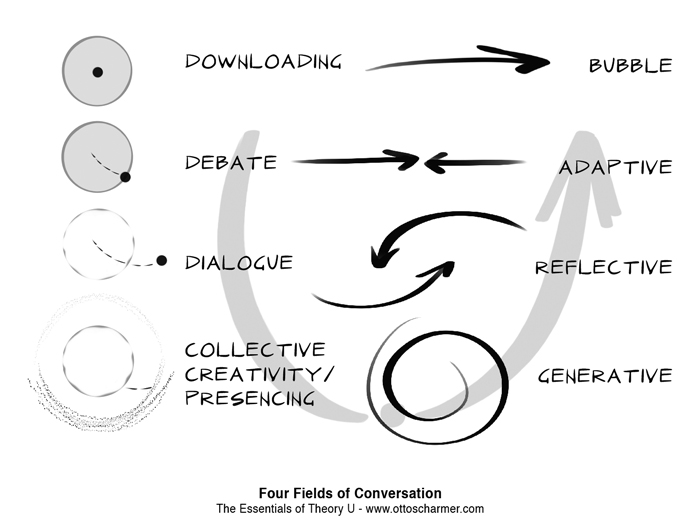
Theory U (ontwikkeld door Otto Scharmer aan MIT), heeft een boeiend kader rond luisteren ontwikkeld, waarin 4 niveau’s te onderscheiden zijn:
Downloading: Op dit niveau luister je niet echt. Selectief vang je enkel de info op die je eigen perceptie/idee bevestigt en versterkt. Ook wanneer je niet meer luistert naar de ander, maar klaar staat om je eigen standpunt te verdedigen, zit je in 'downloading'.
Luisteren naar de feiten: Op dit niveau luister je naar de feiten en ga je het gesprek rationeel analyseren. Je luistert en laat nieuwe informatie toe, ook als die je eigen standpunt tegenspreekt. Dit vereist een bereidheid om jezelf in vraag te stellen en vraagt om een open mind.
Empathisch luisteren: In deze luisterstijl bekijk je de wereld door de ogen van de ander. Het vereist een bereidheid om ons hart te openen en te voelen wat er in de ander omgaat. Hier luister je naar de emoties en behoeften die er aanwezig zijn bij de ander. Het gaat niet enkel over de feiten, maar je bent ook nieuwsgierig waarom deze persoon dit zegt, en wat de diepere drijfveer is.
Generatief luisteren: Op dit niveau van luisteren gaan we voorbij de feiten en de onderliggende emoties. Vanuit een onbevangenheid luisteren we, en maken we ruimte waar iets nieuws kan ontstaan. Pauzes en stilte zijn kenmerkend voor dit soort gesprek. Hier luister je ontspannen en aandachtig: aandacht voor de ander maar ook aandacht voor onze eigen sensaties, gedachten, beelden en verbanden. Als een dans tussen luisteraar en spreker, ontstaat er een creatief dialoog. Beide komen tot nieuwe inzichten als resultaat van de uitwisseling. Het enige wat je hier moet doen is om, vanuit die nieuwsgierige en ontspannen houding, ten volle aanwezig zijn. Dit vraagt een bereidheid om open te staan voor mogelijkheden die het beste naar boven brengen
Deze 4 niveau's geven je een kader om zelf eens te reflecteren op welk niveau je meestal aan het luisteren bent. Elk niveau van luisteren heeft zijn voor en nadelen. Het is niet zo dat je altijd het vierde niveau van luisteren moet hanteren. Wel is het boeiend om te weten dat er verschillende mogelijkheden zijn. Zo kan je in een gesprek gaan schakelen tussen deze niveau's om meer diepgang te creëren, en jezelf uit te dagen om je eigen wereldbeeld te verruimen.
Forget being the best of anything. That’s the fruit of the action. And you do the work for the doing, not the fruit.
It’s an extremely relatable point. When, even in our creative industry, you start wanting to become ‘the best’ — and all of us have worked with people in the advertising industry who want this — you lose sight of your creative self. You become consumed by ‘the fruit’ and forget why you loved creating in the first place. Naturally, your work will suffer.
What Lynch is saying strikes a resemblance to something you’d read in the Bhagavad Gita — the 700 verse Hindu scripture — especially when it reads: “You have the right to work only but never to its fruits. Let not the fruits of action be your motive, nor let your attachment be to inaction.”
Lynch also says this:
Have a great time in the doing, and that’s what it’s all about. If you don’t enjoy the doing then do something else.
After initial concerns earlier in the article that Lynch’s approach might not be relevant to ours, it’s clear here that Lynch’s philosophy applies to ANYONE doing ANYTHING. You must enjoy what you do. And you know what, the results will be better too (but, as mentioned before, that’s still not why you’re doing that particular art-form or work, because that would imply a focus on ‘the fruit’.)

Lynch has removed the distinction between the process and the produce; he could be doing or creating anything and it would still be art. It’s what Duchamp meant when he said, “Whatever an artist points at and considers art, is art,” and what the romantics mean when they say, “The destination doesn’t matter; it is the journey.”
Everything here feels like good rules to live by, but perhaps these aren’t rules that can be learned? There’s a purity to his thinking which implies that this approach came naturally to him. Hell, it is him!
https://medium.com/@two20two/what-can-we-learn-from-david-lynch-a8cb3e8b44db

Wan Xiang. ap
Van boven gezien, ziet het er bijzonder ecologisch uit.
Het lijkt een afbeelding van een levensboom.
Water dat stroomt door de stam en uitwaaiert naar de kruin.
De waarheid is minder prozaïsch.
Het water stroomt hier van boven naar beneden.
Het grootste zoetwatermeer van China, het Poyangmeer, staat extreem laag.
In de bedding zijn kanalen uitgegraven om het water naar de gewassen te doen vloeien.
Deze boom van water valt langzaam droog.
- De Standaard -

this moment decides the next step.
You shouldn’t be five steps ahead,
only the very next one.
And if you can keep to that,
you’re always alright.
You see, but people are thinking too far ahead...
you know what I mean?
Think only what’s right there.
Do only what’s right under your nose to do.
You know?
It’s such a simple thing and people can’t do it, you know.
- Henry Miller -

John Lennon…
about people we admired, and he said to me,
'Y’know, when I’ve discovered someone new, I tend to become that person. I want to soak myself in their stuff to such an extent that I have to be them.'
So when he first found Dylan, he said, he would dress like Dylan and only play his kind of music, till he kind of understood how it worked.
And that’s exactly how I feel about it as well…
I did that, too.
I lived the life, whatever it was…
It was a process of becoming, of transforming into the thing you admire and want to be.
To find out 'what makes it tick.'
Then, hopefully, you’ve absorbed that knowledge and you move on to something else.
- David Bowie -
NITCH